

Forced proximity: how to earn the trope
The forced proximity trope traps two people in the same space (a car, a cottage, one saddle) so they can't avoid each other, and it only works when the trap grows out of choices and danger the reader watched build. We wrote it into two Otome stories with a Danger meter that decides when the walls close in. Here are the numbers behind each forced scene, and what we learned about earning one.
What is the forced proximity trope?
Forced proximity is any setup that keeps two characters in the same space when at least one of them would rather leave.
Read more
Book Riot's Jessica Avery (December 2018) calls it "really an umbrella term for any plot point that forces the two main characters to spend time together", and Bryn Donovan's Writer's Digest list (December 2019) gives 50 versions: business trips, bodyguards, hostages, snowed-in cabins, Antarctic research stations, bandmates.
The common shapes:
- A roomA safehouse, a shared hotel room, a cabin. "Only one bed" is the famous sub-version.
- A vehicleA long drive, a ship, a plane, one saddle.
- A jobA bodyguard, a partner on a case, a trainer and a trainee.
- A deadlineA storm, a closed pass, a vote in nine days: proximity with a clock on it.
On Otome, three stories use it on purpose. In Keep Close the board hires Teo Marsh, a bodyguard who never stops talking, without asking you, and someone keeps sending your perfume back smashed. In Emberfall the wing commander who failed you in the riders' trial has to train you himself, because his own dragon chose you. In Whiteout a blizzard shuts the pass with you in a one-room rescue hut.
Why does forced proximity romance work so well?
Because it takes away the exit, and without an exit every small thing counts. Kirkus's Jennifer Prokop (December 2019) put it as "the charm of the trope is how it supercharges interactions between the characters."
Read more
Galatea's explainer (November 2024) makes the same point from the other side: two people who can't avoid each other have to deal with their differences instead of walking away.
We'd add a second reason, from writing it: proximity shows the reader what a character does with his body before he says anything. Both stories keep a hidden Desire meter for exactly this, and neither lets it become a line of dialogue:
- Keep CloseTeo's Desire rises with "touch, closeness, his tie straightened, a look held too long" and shows "as lost threads mid-sentence, never as a line." The talker loses his words.
- EmberfallDacian's rises with "closeness in the saddle, a hand over his heart, a look held across the brazier" and shows "as him going colder and more formal." The cold man gets colder.
Same trap, opposite tells. That is the useful part of the trope for a writer: put two people a foot apart and you get to show how each one hides.

How do you make forced proximity feel earned, not contrived?
Build the pressure from things the reader watched happen, and only then close the door. The common complaint about the trope is the convenient storm or the hotel with one room left.
Read more
Jericho Writers' version is a couple who book into a hotel and "THERE'S ONLY ONE BED!": fun, but the coincidence is doing the work.
In our stories the pressure is a number. Each of Keep Close, Emberfall and Oathbound has a Danger meter from 0 to 100, and some chapter endings are marked as forced: the moment Danger crosses the line, the chapter ends that way, whatever else was going on. What raises it is written into the files. In Keep Close, noise, lights on, standing at the window and going off alone raise it; finding the card in violet ink adds 4, finding the unbroken window latch adds 4, reading the plate of the car behind you adds 6.
How hard it is to get there is also a design choice. Our director (the model that plays him) may move a meter by at most 10 in one turn, and small talk moves it 0 to 2. Keep Close's Danger starts at 20 and its first forced ending needs 70, so it takes at least five big choices in a row to trigger it in chapter one. Nobody ends up trapped by accident.
What each forced ending does is the other half. Five of the six push the two of you closer: his hand on your back as he gets you out of the dark atelier, the double saddle, the hidden cottage. One, in Oathbound, does the opposite: the Archive's bell rings and Sorin has to leave through the window. He is back at dawn with a practice sword, angrier and closer than before.

How should the space shrink over the story?
In steps, with each step smaller and harder to leave than the last.
Read more
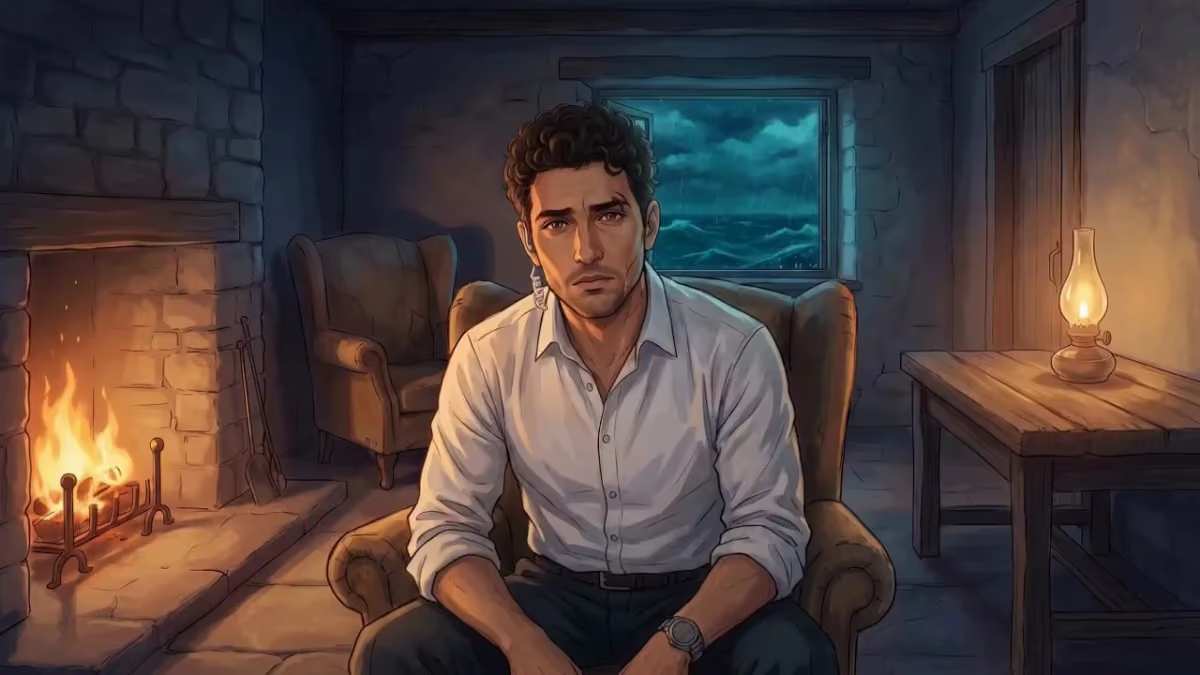
Keep Close is three chapters and three spaces: his whole building (the perfume atelier after midnight), then his car (two seats on the coast road, headlights too long in the mirror), then one room (his stone cottage on the headland, in a storm, the power out). The talker who filled a whole building ends up in a room where silence has nowhere to go.
The part we didn't expect when we drew the routes: every road into chapter three ends in the same cottage. What the player's choices change is how they get there and why:
- Followed home(forced, Danger 85 or more): the car finds you again and he drives you straight to a place nobody knows he has.
- Engine ticking(nothing explained on the overlook): three nights later your flat is broken into, so he brings you there.
- The crash(Trust 45 or more): he has told you why he can't stand silence, and the cottage opens as written.
So the destination is fixed and the arrival is earned. That is a good rule for any forced proximity story: decide the room the climax happens in, then let the reader's choices decide whether they walk in scared, angry or already half in love.
The pressure also compounds. A forced ending raises the next chapter's starting Danger: in Keep Close "Still in the house" opens chapter two 10 higher, and "Followed home" opens chapter three 10 higher. Closeness makes more closeness.

What should happen once they're stuck together?
Give them a job to do with their hands, and let the closeness be a side effect of the job. The weakest forced proximity scenes have two people in a room waiting to kiss. The strongest have them doing something that requires being close.
Read more
Emberfall's second chapter is our clearest case. Dacian trains you alone in the saddle hall at night, the story file says, "because he will not do it in front of the other riders." He makes you fit a harness until your hands bleed. Then he does it himself, buckling it at your waist, his face very close. The next lesson is the bond lesson: your palm flat on his chest, breathing with the dragon. None of it is romantic on paper. It is a drill. That is exactly why it works.
The camera follows the same idea. Our director's rules say to use a wide shot "to place or to put distance between you" and a close one for feeling. The saddle hall opens wide, with the whole hall between you; the buckle is a first-person close-up looking down at his hands.
Chapter three adds the last turn of the screw, and it is not the plot: Ashka, his dragon, won't fly with him alone any more. So you fly together, you in front, Dacian close behind in the double saddle. The proximity comes from a character with her own opinion, not a coincidence.

Should forced proximity ever pull them apart?
Yes: one forced separation makes the next forced closeness land harder.
Read more
Oathbound's first forced ending sends Sorin out of the window when the bell rings, and the chapter after opens with him back at dawn, short-tempered, teaching you to block a blade because you are marked now. Keep Close lets you push it further: send Teo out of the atelier and he goes, cheerfully, then spends the night in his car across the street with the dome light on.
Both are proximity by refusal. The reader tried to create distance and the love interest closed it anyway, in a way that is in character: the assassin with a job to do, the bodyguard who can't stop guarding. Galatea's piece frames the trope as the tension "when two people can't avoid each other". Sometimes the best way to show that is to let one of them try.
Sleep, boss. I've got the door.
How to write forced proximity: a checklist
Before a forced proximity scene goes into a draft, we ask these of it:
- Did the reader watch the pressure build, or does the storm arrive on cue?
- Is there a reason at least one of them would leave if they could?
- Does the space get smaller over the story (a building, a car, a room)?
- Is the climax room fixed, with the reader's choices deciding how they arrive?
- Do they have a task that needs closeness (a harness, a wound, a fire to keep alive)?
- Does closeness change how each one behaves, differently (the talker goes quiet, the cold one goes formal)?
- Is there one moment where somebody tries to leave, and the trope wins anyway?
Read more
If you want premises to practise on, our free romance story generator takes a one-line idea and a trope and writes an original love story from it. For the trope's close cousins, see bodyguard romance and slow burn, and our grumpy sunshine post for how Whiteout gates its one bed.
What this post can't tell you
These are our design numbers, not player data: we don't yet know how many players actually trigger "Followed home" or reach the double saddle, and a threshold that looks tense on paper may feel slow in play.
Read more
The meters move by the director's judgement within fixed limits, so the same choice can land differently from one play to the next. Three stories by one team is a small sample. And interactive stories run short: Keep Close is three chapters, so the slow, many-weeks version of the trope (a whole season on a ship, a year sharing a flat) is something novels do better than we can. The Kirkus and Book Riot lists are good places to find those.


