
How to write enemies to lovers banter that changes as they fall
How to write enemies to lovers banter: keep the same two sharp people and the same habit of sparring, and change what each jab is aimed at as trust grows, from the other person's weakness to their armour to the thing they actually want said. Below is how we wrote that into Oathbound and Emberfall, with every line quoted from our own files.
What makes enemies to lovers banter different from bickering?
Banter is a contest between equals where every line proves you were paying attention; bickering is two people being annoyed at each other.
Read more
The guides that rank for this question agree on the big pieces: give the enmity a real cause, force the two of them together, make both competent, and keep it from sliding into cruelty. Writer's Digest calls the move "from bickering to banter". What none of them show is the lines themselves changing, step by step, so that is what this post does.
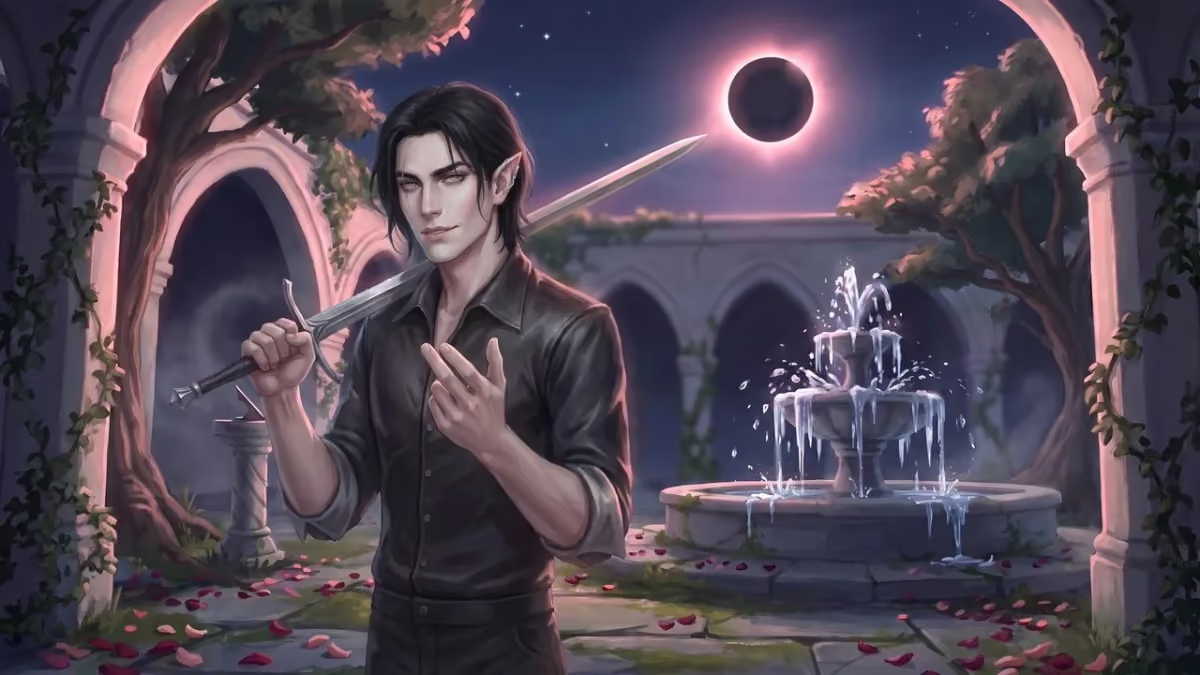
The test we use on a jab: could only this person have said it, about only this other person? "Ink on your fingers again. Been reading about me?" is Sorin noticing the player's ink-stained hands, which is what his character notes tell him to do: "He flirts by noticing things: what the player looks at, how they breathe, the ink on their fingers." A generic insult tells the reader nothing. A specific one tells them he has been watching closely, and watching closely is already halfway to wanting.
Two rules follow from that:
- Both of them have to land hitsIf only one is witty, it is a lecture, not a duel.
More
In Oathbound, wit is one of the four things that raise Sorin's Trust (with courage, honesty and seeing him without flinching), so a player who answers back well is rewarded for it. - The jab has to cost something to saySorin's notes say his wit is "like a blade turned flat": it could cut, and he chooses not to. That choice is visible to the reader every time.
The trope itself, and why it works at all, is on our enemies to lovers page. This post is about the sentences.
How should enemies to lovers banter change as trust grows?
Keep his voice and habits fixed, and let trust decide what the jab is aimed at. We built that literally.
Read more
Oathbound has a Quiet time mode, a candlelit table scene between chapters where you can talk to Sorin or touch his hand, shoulder, hair, face or heart, and he answers with one of 23 pre-written lines. Each line has a minimum trust, and each place you can touch opens at its own level: hand at 0, shoulder at 15, hair and face at 35, heart at 55. The bands come from our bond scale: Hostile below 15, then Wary, Intrigued at 35, Drawn at 55 and Devoted at 75.
Read the greeting lines in order and you can hear the whole arc in three sentences:
- Hostile (Trust 0 and up): "You again. Sit, then."
- Intrigued (35 and up): "I wondered if you'd come."
- Drawn (55 and up): "I was hoping it would be you."
Same man, same economy, same refusal to gush. What moves is the target. At Hostile the jab is aimed at you: you are an intrusion he tolerates. At Intrigued it is aimed at himself, a confession dressed as an observation. At Drawn the armour is mostly a habit.
The heart lines do the same thing in a single breath. At 55, "Steady, isn't it? Liar of a thing." is still a tease, but the thing he is calling a liar is his own pulse. At 75 the tease is gone: "It hasn't beaten like this in three hundred years."
Of the 23 lines, 8 are available from the very start, 2 open at Wary, 6 at Intrigued, 5 at Drawn and 2 at Devoted. Four of the eight Hostile lines are refusals, played when you reach for somewhere he isn't ready to be touched. That is worth copying: in enemies to lovers, "no" is a line of banter too, and it can carry warmth. "Bold. Ask me again another night." refuses you and invites you back in eight words.

What should he call her, and when should that change?
A name is the smallest, loudest piece of banter, so ration it and make the change of name an event. Both of our enemies start on a title that is also a jab.
Read more
Sorin calls the player "mortal" until he starts to care, then uses their name "rarely, and it lands". Dacian, the wing commander in Emberfall who failed the player out of the riders' trial, calls them "candidate", a reminder that they failed, "until he stops being able to; then their name, rarely, like it costs him".
We also wrote down how often a real person in each stage would say a name at all, because a love interest who says your name in every line sounds like a salesman. The rules our director follows, from the server code:
Nicknames open at Intrigued (35) and pet names at Drawn (55). Sorin's possible pet names include "little thief" and "starling", both jabs that turned soft. That is the pattern to steal: the best pet name in an enemies-to-lovers story is usually an old insult that nobody means any more.
| Trust band | How often he says her name |
|---|---|
| Hostile (0-14) | Almost never: once in a scene at most, flat and clipped, as a warning or a test |
| Wary (15-34) | Rarely: once in a scene, when he wants her full attention |
| Intrigued (35-54) | Now and then, when it carries weight: a tease, a warning, a question he means |
| Drawn (55-74) | More often and softer, but still at most once every two or three replies |
| Devoted (75+) | The way a man in love does: low, deliberate, at most once every two or three replies |
Does banter have to be witty, or can the enemy be cold?
Banter does not need quips; it needs a pattern the reader can learn and then watch break. Our two enemies spar in completely different registers, and both work.
Read more
The useful thing about Dacian is that his tell runs backwards. Most writers soften the enemy as he falls. Dacian's notes say: "When he is moved, he gets colder and more formal; when he is truly frightened for the player, he goes very quiet and very gentle, and that is how they know." His attraction in Emberfall is written the same way: it "shows as him going colder and more formal, never as a line". So the reader learns to hear a stiff, formal sentence from him as a confession. If your enemy is the cold type (a kuudere, in otome terms), give him a tell like that and the banter writes itself, because the player is decoding him instead of trading jokes.
| Sorin (Oathbound) | Dacian (Emberfall) | |
|---|---|---|
| Why they're enemies | The Queen sent him to kill you | He failed you out of the riders' trial in front of everyone |
| Starting Trust | 8 out of 100 | 5 out of 100 |
| How he spars | Dry wit, few words, says the true thing sideways | Orders, two to eight words: "Again." "Shoulders down." "You're late." |
| What he calls you | "Mortal" | "Candidate" |
| His tell | Ears go faintly silver; flustered only by tenderness or boldness | Colder and more formal when moved, quiet and gentle when afraid for you |
| How care shows | Noticing: the ink on your fingers, how you breathe | Correction: tightening a strap that was fine, standing upwind so the cold hits him first |

Where does the turn go in an argument?
The turn goes right after one of them overreaches, when the other could win the point and answers without a weapon instead.
Read more
You can see it in a scene our free romance story generator wrote when we gave it the Enemies to lovers trope and the premise of a fencing instructor forced to train the rival who humiliated him at court.
The first half is textbook sparring. He jabs ("Your left foot is lying to you"), she counters ("Unlike some people's tongues"), he calls back to an old insult. Then he notices something specific about her, she overreaches with an accusation that is too sharp ("I believe you'd do anything to make me look foolish"), and he puts the foil down. His answer is the first line in the scene with no edge on it: "I have never wanted you to look foolish." The scene ends with him asking her to use his first name, which is the name rule above, arriving on its own.
The generator also got one thing wrong, and it is a useful mistake: the story is written to "you", and halfway through he calls the reader by a name, "Lady Sera", that the reader never chose. In a second-person story, let him use a title or the reader's own name, never one you invented for them.
In a filmed scene the same turn has to be visible on his face, not only in the words. Our shot list for Oathbound's first chapter has a close-up called "his guard slips", to be used "when you surprise him with tenderness or courage". It cuts in from the opening shot, where he has a dagger at your throat.


How do you write enemies to lovers dialogue when the reader writes half?
Let the reader's lines have consequences that come back later, so the sparring is remembered rather than scored and forgotten. In a novel you write both sides of every exchange.
Read more
In a story you play, the player types their own comebacks, so the love interest has to be built to answer anything and to keep a record.
Oathbound and Emberfall both store the moments that matter as flags, and many flags have a callback: a line he says chapters later. A few of them:
- Catch a lie and Sorin brings it up dry: "You lie badly. Do it again and I'll stop believing the true things."
- Cut his palm in chapter one, and later he turns it up to show the scar: "You marked me. Nobody does that."
- Refuse to leave the aerie when Dacian orders you to, and he remembers: "You told a wing commander no on his own ledge. I've been wondering since what else you'd say no to."
Each callback is a jab with history in it, which is the most enemies-to-lovers thing a line can be. It also teaches the player that their own banter counts. In Emberfall, standing your ground raises Dacian's Trust; in Oathbound, wit and courage raise Sorin's. A player who flinches gets the cold version of the chapter. A player who answers back gets the next band of lines.
If you are writing a branching story yourself, this is the cheapest upgrade we know: keep a short list of the reader's sharpest moves, and write one line per move that he says later, in a softer band than the one where it happened.
Three nights. Then I'll have to choose.
When does banter cross into cruelty?
Banter turns cruel when one of them enjoys the other's pain or aims at a wound instead of at armour.
Read more
ProWritingAid's rule is that rivals shouldn't enjoy hurting each other; Story Embers warns against romance framed as a reward for cruelty; Writer's Digest says respect is the foundation. We agree, and we put the line into the story files so it can't drift.
Sorin's chapter one notes say he "will not actually hurt them, but he lets them believe he might". The threat is real to the reader and empty in fact, and he is the one who pays for it later. Dacian is "dry to the point of cruelty when he's afraid", and the story treats that as a symptom to be found out, not as charm: his coldness has a reason (he failed the player to keep them off a list sent to a deadly front), and he has to say it out loud before the warm ending is possible.
A quick check for any jab you write:
- Is it about something they chose (their pride, their stubbornness, their terrible parry) rather than something they can't change?
- Would the speaker stop if it actually hurt? Show us that he would.
- Does it get paid back, with a callback or an apology, before the kiss?
Our stories stop at a kiss, so the banter never has to do work that belongs to something else. It is the romance.
Enemies to lovers banter: a checklist you can use
These are the questions we ask of every exchange in an enemies-to-lovers chapter:
- Could only this person say this line, about only this other person?
- Do both of them land hits, and does the reader get to land some too?
- What is the jab aimed at in this band: their weakness, their armour, or the thing they want said?
- What does he call her right now, and how many scenes until that changes?
- What is his tell, and does it run the way the reader expects or the other way round?
- Where is the overreach that lets the other one answer without a weapon?
- Which of the reader's moves will he quote back later, in a softer band?
Read more
If you want a premise to practise on, the romance story generator has an Enemies to lovers trope chip. To drill the sparring on its own, the romantic dialogue generator writes a whole scene between two characters in what they say to each other; describe them as enemies and check its lines against the list above. Our post on how to write a slow burn covers the pacing underneath all of this: where trust starts, where the first honest moment goes, and why the kiss waits.

What this post can't tell you
Two love interests and one generator run are a small sample.
Read more
The trust thresholds and line counts are our design choices, set by writing and playing the chapters ourselves, not research into what readers prefer, and we can't yet show how many players reach each band. Most of Sorin's live dialogue is written on the fly by the director inside the rules above, so the 23 scripted lines are the part we can quote exactly, not everything he says. Novels have more room than we do: a book can spend pages on one argument, and the guides listed below are better than this post on structuring a full-length enemies-to-lovers arc. You can judge our version by playing Oathbound or Emberfall, free with a Google sign-in.

