How we film an AI love interest
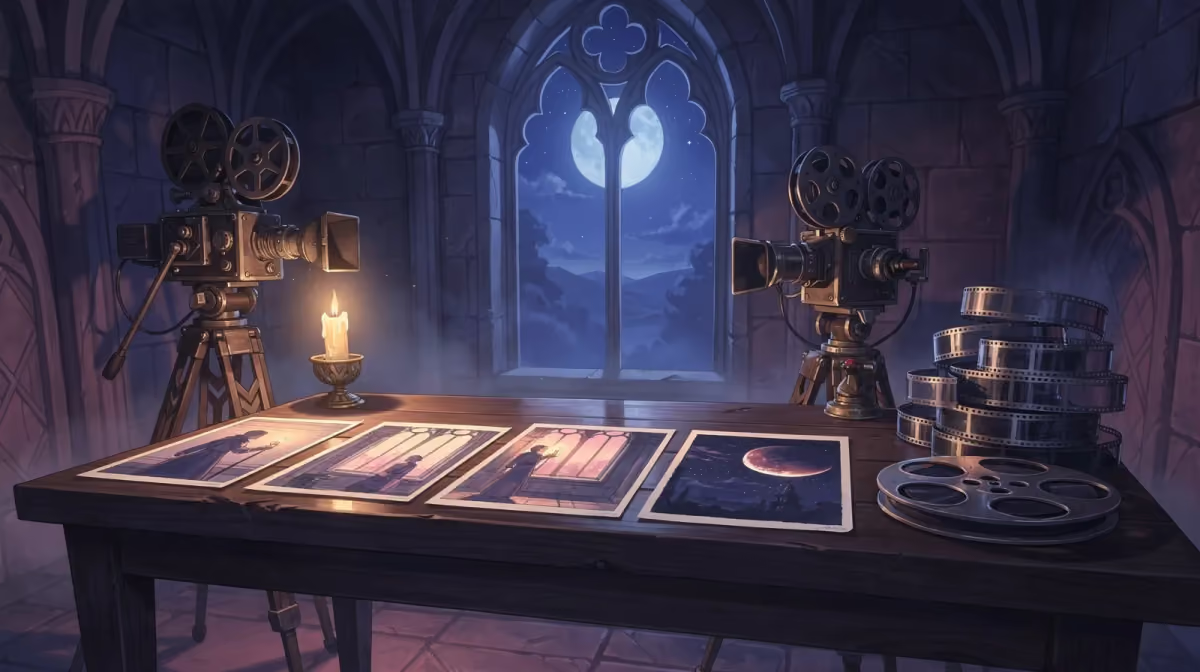
This is how we film an AI love interest for Otome: every moment of a story is a shot on a list, each shot starts as a painted keyframe, and an image-to-video model turns it into a five-second clip that the story cuts between while you play. Here is the real pipeline, with the frames, the model test and the costs.
What does "filmed" mean on Otome?
Filmed means every moment you see is a short video clip, not a still sprite with a mouth that flaps. When the love interest leans in, looks away or laughs, a clip of him doing exactly that plays.
Read more
The story's director, a language model following the chapter we wrote, picks the next shot by its id after every message you send, the same way an editor cuts between takes.
Almost nothing is filmed while you play. The story's clips are made ahead of time, so a scene starts as fast as a video loads. When the director needs a moment no filmed shot covers, it can ask for a new one a few times a session: the scene keeps playing the closest existing shot while the new one is filmed in the background, and the new shot is kept for every later player. You can see it in the first ten seconds of Keep Close, which opens on Teo mid-sentence in a perfume atelier.

How many shots does one AI love interest need?
More than you would guess, and fewer than a film. Oathbound, our four-chapter romantasy, has 29 story shots: 19 loops and 10 one-off actions. Keep Close, three chapters of romantic suspense, has 15: 8 loops and 7 actions.
Read more
Teo, Keep Close's love interest, also has a character pack of 14 emotion clips (smirk, blush, alert and so on) that every chapter can cut to.
Each shot on the list is a few lines of plain description:
- seewhat the moment is ("POV: your hands straighten his loosened tie. He stops talking mid-sentence.").
- framethe first frame to paint.
- endfor an action, the frame it has to land on.
- motionwhat moves, and how the camera behaves.
- anchorsspots on the frame you can touch (his tie, a bottle, a candle), as fractions of the 16:9 picture.
That list is the real script of the story. The chapters say what has to happen; the shots decide what you get to see.

How does a painted keyframe become a clip?
In three steps, all run by one script in our repo.
- Paint the keyframeAn image model paints the first frame from two references: the love interest's portrait, so his face stays his face, and the place's background still, so the room stays the same room.
More
Since 11 November 2026 we paint keyframes with FLUX.3 edit at 16:9 and 1K, about $0.05 a frame at list price. Portraits and place stills are still painted at 2K. - Paint the end frame, for actionsA one-off action, like straightening his tie, needs a target.
More
We edit the start frame into the end of the action ("he has stopped mid-word, looking down at her hands, then up, a flush rising on his cheekbones"). - AnimateAn image-to-video model gets the start frame, the end frame (or the start frame again, for a loop) and the motion line, and returns a clip of about five seconds.
Read more
A loop that starts and ends on the same frame can repeat forever without a visible seam, so he can stand, breathe and listen for as long as you take to type. Shots where he talks now get a mouth chart: one lip-sync of the loop, about $0.20, gives seven mouth shapes, and the player draws the right one over the loop for every moment of his voice, scripted or live. Shots filmed before 11 November 2026 still play a second talking loop instead.

Why are some shots filmed from your point of view?
Because in a romance you play, the most important hands in the frame are yours. Shots marked POV show the heroine's hands: on his cheek, on his tie, taking his wrist. That raises a problem a normal film never has: the hands have to look like the player's.
Read more
So POV shots are filmed again for different heroine looks, changing skin tone, sleeves, nails and jewellery while the rest of the shot stays the same. We pre-film the common looks (olive, caramel and deep skin tones, for a start) and the rest are filmed on demand the first time someone picks them. Our repo holds 54 pre-filmed look files today, counting each clip with its poster and end frame.
Locks up at one. Talks to her bottles. Laughs at her own jokes. Which, fair.
Which video model films our AI love interest, and why?
Oathbound was filmed on Kling v4 at 720p, which costs about $0.79 a clip.
Read more
Before filming more characters, we ran a blind test on 7 November 2026: 7 Oathbound shots on 7 model settings, 49 new clips, $13.32 in total, with the shipped Kling clip as the baseline. The shots were chosen to be hard: a kiss, a palm on his cheek, a waltz dip, a rooftop loop.
The winner, and now the default for every story and character we film, is MiniMax H3 Max Turbo at 768p, with one setting changed. It costs $0.207 a clip at list price, renders in about 5 seconds instead of a minute or two, and honoured every start and end frame. Kling v4 still keeps faces and painterly detail closest to the keyframe, but only Oathbound, filmed before the test, is on it.
| Model and setting | Cost per clip (list) | What happened in our test |
|---|---|---|
| Kling v4, 720p | $0.785 | Most natural acting, no artifacts; faces closest to the keyframe |
| MiniMax H3 Max Turbo, 768p, no prompt expansion | $0.207 | Clean loops, every end frame honoured, about 5 seconds to render |
| MiniMax H3 Max Turbo, 768p, default expansion | $0.207 | Rewrote prompts into multi-shot scripts: a mid-clip cut, an orange relight |
| Wan 3.0, 720p | $0.50 | Kept the start frame but jumped to the end frame on the last frame only |
| Seedance 2.0 Mini, 480p | $0.35 | Ignored the end frame and redrew the characters in another style |
| Kling v3 Standard, 720p | $0.42 | Perfect seams, but idle loops were nearly frozen |

What went wrong when we tried cheaper models?
The setting that mattered most was one we didn't know about. H3's default prompt expansion rewrites your motion line into a little multi-shot script before filming.
Read more
In our test that produced a hard cut halfway through a clip, an orange relighting of a night sky and invented dialogue. Turning expansion off removed all three, and halved the render time from 8.7 to 4.7 seconds.
Two other failures are worth knowing if you are building something similar:
- End frames that aren't really end framesWan 3.0 lets the shot drift wherever it likes, then pastes the target image onto the very last frame, a one-frame jump. That broke 4 of 7 shots at 480p and 5 of 7 at 720p.
- Redrawn charactersSeedance 2.0 Mini changed the art style from frame 0 and, in the kiss shot, swapped the heroine for a different woman. For a story where his face is the point, that rules it out.
No model refused any shot in the test, including the kiss: 0 refusals in 56 tries with every safety checker left on. Romance on Otome stops at a kiss, and that line was never a problem for the models.

What happens to a clip after it's filmed?
Two more passes make the clips feel less like video and more like a person in front of you.
- DepthA depth model makes a greyscale map of every looping shot's first frame (bright is near).
More
In the browser, the playing video is displaced by that map as you move your phone or mouse, which gives a little parallax. - Face, cheeks and heartA vision model finds his face, both cheeks and the left side of his chest in each loop.
More
That is how a blush can land on his cheeks when you say something that gets to him, and why a heartbeat effect sits on his chest rather than floating in the air.
Read more
His voice is generated too. Scripted lines, like the cold open, are voiced once and saved, so they play instantly. Replies written during play are voiced as they arrive.
What does one AI love interest cost to film?
For a 14-clip character pack like Teo's, our test priced it at $10.99 on Kling v4 and $2.90 on H3 at list price ($2.03 during fal's November discount).
Read more
A full story adds its own shots on top: Oathbound's 29 shots on Kling v4 come to roughly $23 before any refilms, and refilms happen. A clip with a doubled hand or a drifting face gets deleted and filmed again.
That is cheap next to drawing animation by hand, and expensive next to a still sprite. It is also why every love interest on Otome is an original character: we design his portrait first and film everything from it, so there is no one else's art in the pipeline. If you want to see where it starts, the AI boyfriend generator uses the same first step of describing him in words.

What are the limits?
Being honest about where this falls short:
- Faces drift a little on the cheaper modelH3 re-renders the first frame instead of keeping its pixels, so we take the poster from the clip itself, or the cut from poster to video would jump.
- Five seconds is shortLong actions get split into two shots, and anything with many moving people (a crowded ballroom) is the hardest to keep clean.
- We test by eyeOur scores are our own review of contact sheets, plus a few measurements of how closely each clip matches its keyframe, not a panel of viewers.
Read more
If you would rather see the result than read about it, both stories start free in the browser with a Google sign-in: Oathbound, filmed on Kling v4, and Keep Close. For more filmed romance you can play online, start at our visual novel online page.

